
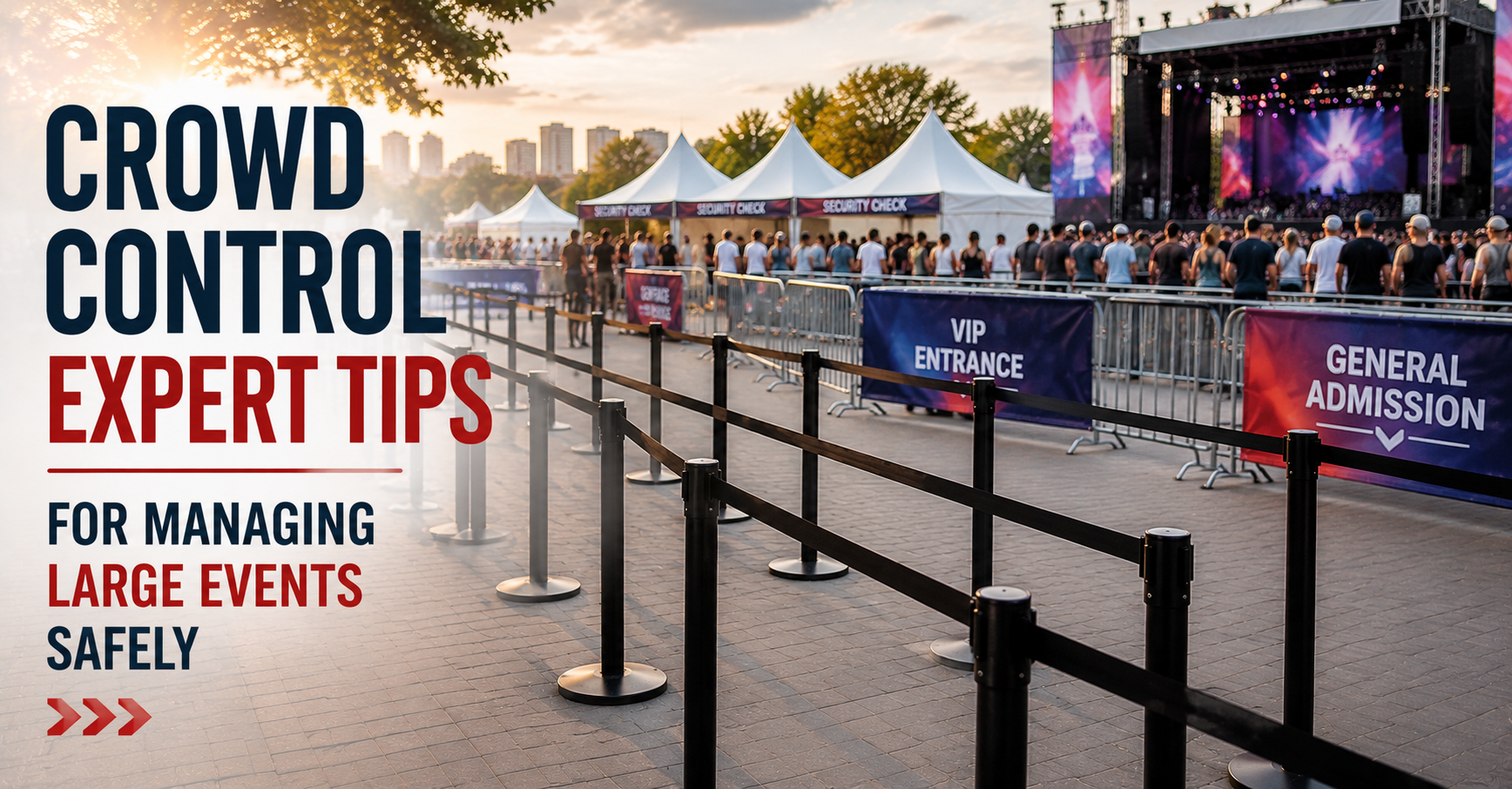
Crowd Control Expert Tips for Managing Large Events Safely
Large events create complex pedestrian movement because thousands of individual decisions about where to enter, wait, move, gather, and leave happen within the same environment. As crowd size increases, effective crowd control and crowd management become important parts of thoughtful event planning, particularly when organizers need to maintain predictable crowd flow across entrances, queues, gathering areas, and exits.
A practical crowd management plan can bring together crowd management strategies, crowd control strategies, clear communication, staff coordination, monitoring, queue organization, appropriate equipment, and event security. These measures can support more organized movement and safer event operations, but good planning cannot guarantee that crowd-related incidents will never occur.
Crowd Control Expert Tips for Managing Large Events Safely
Crowd control at large events works best when organizers combine advance planning, clear pedestrian routes, organized queues, appropriate barriers and stanchions, visible signage, trained personnel, and ongoing monitoring. Effective crowd control should guide how people enter, move through, gather within, and exit an event while allowing teams to identify and respond to changing crowd conditions.
Managing large-scale events involves more than estimating attendance and placing barriers around busy areas. Thousands of individual decisions about where people enter, wait, move, gather, and leave can create constantly changing crowd dynamics. Effective crowd control brings these movements into the wider event plan through thoughtful pre-event planning, communication, staffing, monitoring, queue organization, and appropriate equipment.
For event organizers, the goal is to create an organized environment where pedestrian movement can be observed and managed as conditions change. The following crowd control tips cover practical considerations for event crowd management, from Entry and Exit planning and queue management to crowd density monitoring, emergency procedures, and staff coordination.
Start With Pre-Event Planning and Risk Assessment
A strong crowd-management approach begins before attendees arrive. Pre-event planning gives organizers an opportunity to review the venue, expected crowd size, activities, pedestrian routes, and potential pressure points.
Conduct a Venue-Specific Risk Assessment
A risk assessment should consider the characteristics of the specific event site rather than relying on a generic plan. Event organizers can review:
- Expected attendance and crowd density
- Venue layout and available space
- Entry and Exit points
- Emergency exits and evacuation routes
- Queues and waiting areas
- High-density zones
- Pedestrian routes and potential bottlenecks
- Attractions likely to draw large groups
- Staffing and communication requirements
- Applicable safety protocols
This process can help identify opportunities for risk prevention and inform practical crowd control strategies.
Consider Different Event Settings
Crowd conditions can vary significantly between concerts, festivals, sporting events, conferences, exhibitions, and other event settings. A strategy that works for an indoor conference may not be suitable for an outdoor festival or a venue with multiple access points.
Custom-tailored solutions can account for the particular layout, activities, expected attendance, and operating conditions of each event.
Plan Entry and Exit Points Carefully
Entry and Exit management is a central part of crowd control. Large numbers of people arriving or leaving at the same time can create congestion, particularly where routes are narrow or multiple pedestrian movements intersect.
Organize Entry Points
Entry planning can include reviewing the number and location of access points, queue arrangements, screening procedures, signage, and staff positions. Organizers should also consider how arriving attendees will transition from the entrance into the main event area.
Review Emergency Exits
Emergency exits should remain clearly identified and incorporated into the event’s planning and evacuation arrangements. Staff should understand relevant routes and responsibilities without allowing temporary crowd-control arrangements to interfere with established emergency access.
Consider Departure Patterns
Crowds may behave differently when an event ends than when it begins. Organizers can consider whether attendees are likely to leave gradually or whether a large group may move toward the same exits within a short period.
Understand Crowd Psychology and Crowd Behaviour
Understanding crowd psychology can help event teams anticipate why people may gather, change direction, or follow particular routes. Crowd behaviour is influenced by factors such as event programming, signage, social interaction, delays, perceived points of interest, and information provided to attendees.
Consider How People Naturally Move
People do not always follow the route an organizer expects. They may choose a shorter path, gather near friends, follow a visible group, or move toward an attraction that has suddenly become popular.
Considering these patterns during planning can improve crowd flow support and help identify areas that may require additional monitoring.
Monitor Changing Crowd Dynamics
Crowd dynamics can change throughout an event as attendance levels, activities, and conditions change. A space that is relatively open early in the day may become a high-density zone later. Learn more about Managing Long Lines: A Guide for High-Traffic Businesses.
Monitoring should therefore continue throughout the event rather than ending once attendees have entered.
Manage Crowd Density and High-Density Zones
Crowd density describes how concentrated people are within a particular area. Managing density involves more than monitoring total attendance because a venue can contain both relatively open areas and highly concentrated groups at the same time.
Identify High-Density Zones
Common high-density locations may include:
- Stages and performance areas
- Entrance and ticketing points
- Food and beverage areas
- Merchandise counters
- Restrooms
- Popular attractions
- Narrow corridors
- Transportation pickup points
- Main exit routes
Identifying these locations during planning can help organizers determine where crowd flow support and monitoring may be most useful.
Use Operational Crowd Control Strategies
Operational crowd control strategies may include repositioning staff, adjusting queue layouts, improving directional information, opening additional service points, or redirecting pedestrian movement when appropriate.
The specific response should be based on current conditions and the event’s established procedures.
Build an Effective Queue Management System
Queue management can help organize waiting areas and reduce unnecessary interference with surrounding pedestrian routes. Poorly positioned queues can extend into walkways, block access points, or create additional congestion.
Define Queue Areas
Designated queue spaces give attendees a clearer understanding of where to wait and how the line progresses. The layout should consider expected queue length, available space, accessibility, and surrounding pedestrian movement.
Monitor Queue Growth
Staff can observe whether queues are growing, moving slowly, or affecting nearby routes. Depending on the circumstances, event organizers may adjust the queue configuration, provide additional information, or coordinate with operational teams.
Select Appropriate Crowd Control Equipment
Physical equipment can support crowd flow management, but it should be selected according to the environment and intended function.
Use Crowd Control Barriers and Stanchions
Crowd control barriers can help establish boundaries or separate pedestrian areas, while crowd control stanchions can be useful for temporary queues and directional guidance.
Equipment selection should consider:
- Expected pedestrian traffic
- Required stability
- Indoor or outdoor conditions
- Temporary or recurring use
- Required level of physical separation
- Available space
- Compatibility with signage or other accessories
These event crowd solutions should complement rather than replace broader planning and staff coordination.
Coordinate Security Teams and Event Staffing
Effective crowd management depends on people as well as equipment. Security teams, event staff, supervisors, and other personnel should understand their respective roles before the event begins.
Define Staff Responsibilities
Event staffing plans may identify who is responsible for entrances, queues, high-density areas, pedestrian routes, communication, and escalation. Clear responsibilities can reduce uncertainty when conditions change.
Use Crowd Management Training
Crowd Management Training can help personnel understand crowd observation, communication, queue organization, venue procedures, and escalation processes. Training should reflect the specific role and environment.
Venue-specific training can be particularly useful because staff need to understand the actual layout, access points, emergency exits, communication channels, and procedures used at the event.
Consider Professional Crowd Management Services
For complex or high-attendance events, organizers may consider professional crowd management services or Crowd Management Services where appropriate. Depending on the event, these services may provide planning support, trained personnel, monitoring, or other specialized assistance.
Crowd Control Guards and Crowd Control Security Services may also have defined roles within a broader event-management structure, depending on local requirements and the scope of the engagement.
Prepare for Emergencies and Changing Conditions
Good crowd control planning should include appropriate emergency response and contingency arrangements. These plans should reflect the specific event, venue, hazards, and applicable requirements.
Develop Emergency Response Protocols
Emergency response protocols should clearly establish how concerns are communicated and escalated. Personnel should understand relevant emergency procedures and their responsibilities during an incident.
Review Evacuation Plans
Evacuation plans should identify appropriate routes and emergency exits and consider how attendees may move through the venue under changing conditions. Temporary crowd-control equipment should be considered as part of this overall layout.
Include Contingency Planning
Contingency planning allows organizers to consider potential changes such as severe weather, unexpected crowd growth, operational delays, transportation disruption, or changes to venue access.
The objective is to give event teams a structured way to respond rather than relying entirely on decisions made during an incident.
Monitor Conditions During the Event
Crowd management does not end when the event opens. Continuous observation can help teams identify changes in pedestrian movement, queue growth, or crowd density.
Use Crowd Monitoring
Depending on the event, crowd monitoring may involve staff observation, attendance information, counting methods, or technology. The appropriate approach depends on the venue, event size, resources, and applicable requirements.
Support Incident Response
When staff identify an issue, they should follow the event’s established communication and incident response procedures. This may involve notifying supervisors, coordinating with security teams, adjusting pedestrian routes, or escalating the concern to the appropriate personnel.
Document and Review Crowd Management Performance
Post-event review can provide useful information for future planning. Incident reports, staff observations, queue data, and operational feedback can help identify recurring issues.
Review What Happened
Event organizers can examine where congestion occurred, which queues grew unexpectedly, how attendees responded to directional information, and whether staffing levels matched actual conditions.
Improve Future Event Planning
Lessons from previous events can inform future crowd management strategies, staffing arrangements, venue layouts, and equipment selection. The aim is continuous improvement rather than assuming that one event plan will work unchanged for every future event.
Practical Crowd Control Tips for Large Events
Before and during a large event, organizers can consider:
- Complete a site-specific risk assessment
- Review expected crowd size and potential crowd density
- Map pedestrian routes and likely high-density zones
- Plan Entry and Exit arrangements
- Identify and review emergency exits
- Establish clear queue management procedures
- Use appropriate crowd control barriers or stanchions
- Provide clear signage and communication
- Coordinate security teams and event staffing
- Provide appropriate Crowd Management Training
- Establish emergency response protocols
- Prepare contingency and evacuation plans
- Monitor crowd behaviour and changing crowd dynamics
- Document incidents and review outcomes after the event
Putting Crowd Control Into Practice
Effective crowd control is a combination of planning, people, communication, monitoring, and appropriate physical measures. Event crowd management should consider how attendees are likely to move through the venue, where density may increase, how queues will operate, and how teams will respond when conditions change.
For large-scale events, there is no single crowd control strategy that applies to every venue or situation. Site-specific risk assessment, appropriate staffing, operational crowd control strategies, and well-defined emergency procedures can support more organized event operations.
Professional Crowd Management Services may be appropriate when an event involves complex layouts, high-density conditions, significant operational requirements, or specialized safety considerations. Good planning can support crowd safety and event safety, but it cannot guarantee that crowd-related incidents will never occur.
How Does Crowd Control Work at Large Events?
1. Assess the Event and Venue
Review expected attendance, venue size, event schedule, entrances, exits, attractions, service points, temporary structures, and known pedestrian routes.
2. Identify Crowd-Density Hotspots
Look for locations where people are likely to gather or slow down, such as entrances, stages, concessions, ticketing areas, security screening, washrooms, and narrow pathways.
3. Design Clear Pedestrian Routes
Establish understandable movement patterns using appropriate lanes, signage, stanchions, barriers, and staff guidance.
4. Organize Queues and Access Points
Plan waiting areas so they remain understandable and do not unnecessarily interfere with major pedestrian routes.
5. Monitor Crowd Conditions
Observe crowd movement, queue growth, congestion, and other changing conditions throughout the event.
6. Adjust According to Established Procedures
Modify staffing, communication, routing, queue layouts, or access arrangements when conditions require changes.
Common Crowd Control Challenges and Planning Responses
| Crowd Control Challenge | Common Cause | Possible Planning Response |
|---|---|---|
| Entrance congestion | Large arrival waves | Review entry lanes, staffing, signage, and arrival procedures |
| Long queues | Limited service or screening capacity | Improve queue organization and monitor queue growth |
| Cross-traffic | Opposing pedestrian routes | Separate flows where practical |
| Localized crowd density | Popular attractions or gathering points | Monitor concentration and review circulation routes |
| Confusing directions | Insufficient wayfinding | Improve signage and staff communication |
| Exit congestion | Large numbers leaving simultaneously | Review departure routes and exit procedures |
| Queue overflow | Demand exceeds planned waiting space | Prepare flexible overflow layouts |
| Blocked pathways | Poor equipment or activity placement | Review barriers, queues, and temporary installations |
These are general planning considerations, not universal solutions. The appropriate response will depend on the specific event, venue layout, expected crowd size, staffing, operating conditions, and applicable requirements. Event organizers should use site-specific risk assessments and professional guidance where the complexity or density of an event warrants it.
Frequently Asked Questions About Crowd Control at Large Events
1. What is crowd control at an event?
Crowd control is the organized management of how people enter, move through, gather within, and leave an event. It may involve queues, pedestrian routes, signage, staff, monitoring, and physical barriers.
2. Why is crowd control important for large events?
Crowd control helps organize pedestrian movement and manage changing crowd conditions. It can help address congestion around entrances, queues, attractions, and exits as part of broader event safety planning.
3. What should a crowd control plan include?
A crowd control plan may include attendance, Entry and Exit arrangements, pedestrian routes, queues, staffing, communication, monitoring, and emergency procedures. A site-specific risk assessment can help determine appropriate measures.
4. How can organizers reduce crowd congestion?
Organizers can reduce potential congestion through planned pedestrian routes, queue management, clear signage, and monitoring. Staff or layouts may be adjusted when conditions change.
5. What is the difference between crowd control and crowd management?
Crowd control focuses more directly on regulating pedestrian movement, while crowd management covers broader planning and coordination. Both can include staffing, communication, monitoring, risk assessment, and physical equipment.
6. How do stanchions help with crowd control?
Stanchions can define queues, create temporary boundaries, and guide pedestrian movement. Their suitability depends on traffic levels, stability requirements, venue conditions, and intended use.
7. When should crowd control barriers be used?
Crowd control barriers can help define boundaries, separate pedestrian areas, or guide movement. The appropriate type depends on crowd density, expected traffic, environment, and required physical separation.
8. How can event organizers manage large queues?
Organizers can use designated waiting areas, clear directions, appropriate staffing, and queue monitoring. Flexible layouts can help when queue lengths change during an event.
9. What areas of an event are most likely to become crowded?
Entrances, exits, stages, food areas, restrooms, ticketing points, and popular attractions commonly attract larger groups. Identifying these high-density zones can help guide monitoring and crowd-flow planning.
10. How can crowd density be monitored during an event?
Crowd density can be monitored through staff observation, crowd counting, attendance information, or suitable technology. The appropriate method depends on the event, venue, resources, and applicable requirements.
11. What role do security teams play in crowd management?
Security teams can assist with access procedures, observation, communication, and established escalation processes. Their responsibilities should be clearly defined within the broader event plan.
12. Can good crowd control prevent every crowd-related incident?
No, crowd control cannot guarantee that every crowd-related incident will be prevented. Planning, monitoring, communication, staffing, and appropriate equipment can help teams prepare for changing conditions.
Plan Ahead for Effective Crowd Control
Before the event, review expected attendance, pedestrian routes, crowd-density hotspots, queues, entrances, exits, signage, staff responsibilities, and crowd control equipment. A practical review can help identify potential congestion points and support more organized event operations.
For events involving significant size, complexity, high crowd density, or specific regulatory requirements, consider consulting qualified crowd-management, event-safety, security, or other appropriate professionals. Their expertise can help ensure planning and operational measures are suited to the specific event and venue.