
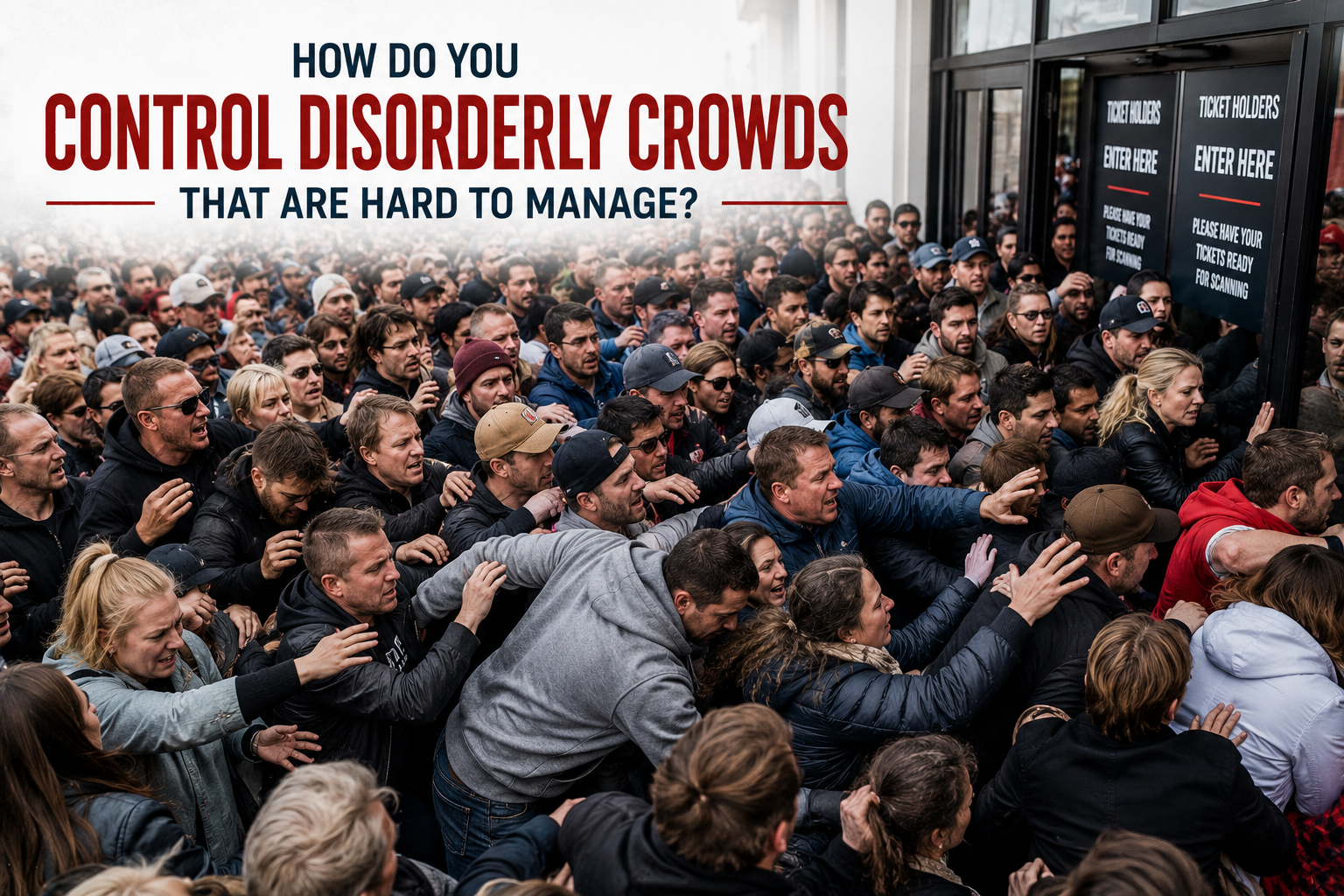
How Do You Control Disorderly Crowds That Are Hard to Manage?
A DISORDERLY CROWD can quickly become overwhelming — and even dangerous — when movement is unpredictable and people don’t know where to go. In busy venues, effective crowd control and crowd management are essential parts of event risk management and overall crowd safety. Managing large groups requires more than supervision alone — it takes planning, structure, and proven strategies.
What crowd control methods work best for high-risk situations?
Here’s how effective crowd management helps keep even the most challenging crowds organized, controlled, and safe.
Controlling disorderly crowds starts with clear structure, visible guidance, and proactive management. The most effective approach is to organize movement before problems begin. Crowd control stanchions help create defined pathways, prevent bottlenecks, and reduce confusion that often leads to frustration or pushing.
Pair physical barriers with clear signage, staff presence, and consistent communication so people know where to go and what to expect. Monitoring crowd flow in real time also allows you to adjust layouts quickly if congestion builds.
In short, well-planned space management, visible boundaries, and active supervision are the key to keeping difficult crowds safe, orderly, and manageable.
What factors lead to disorderly or aggressive crowd behavior?
Disorderly or aggressive crowd behavior rarely happens without warning. In most situations, it’s the result of pressure building up — physically, emotionally, or environmentally — until people begin reacting instead of cooperating. Understanding these triggers is essential for better crowd control, smarter crowd management, and stronger event risk management planning.
Some of the most common factors include:
- Overcrowding and congestion — When spaces feel too tight or movement slows down, frustration rises quickly and patience disappears.
- Poor communication or unclear direction — Confusion about where to go, how long to wait, or what’s happening can make people anxious or irritated.
- Long wait times or perceived unfairness — If people feel ignored, delayed, or treated unfairly, tension can escalate fast.
- Environmental stressors — Heat, noise, limited ventilation, or discomfort can intensify emotional reactions.
- Presence of intoxicated individuals — Alcohol or substance use can lower inhibitions, impair judgment, and increase impulsive or aggressive behavior.
- Lack of visible structure or authority — When boundaries, guidance, or supervision are missing, people are more likely to push limits or ignore order.
Recognizing these risk factors early helps organizers respond proactively, improve crowd safety, and create conditions that support calm, cooperative movement instead of chaos.
What crowd control methods work best for high-risk situations?
High-risk environments demand more than basic organization — they require layered crowd control strategies that combine planning, technology, and trained personnel. Whether managing mass gatherings, concerts, sporting events, or busy public venues, effective crowd management depends on preparation, visibility, and fast response.
Here are the methods most trusted by event organizers, event/venue managers, and security personnel across the event industries:
Clear physical boundaries and guided movement
- Use retractable ropes, barriers, and fence screens to define walkways, queues, and restricted areas.
- Structured layouts support safe movement, reduce pressure points, and help prevent crowd collapse or surges.
Strong access control and entry management
- Implement controlled entry points, ticket verification, and screening procedures.
- Enforce drinking age enforcement where applicable to reduce risks from intoxicated attendees.
- Well-planned access control supports smoother flow and improves overall Customer Experience.
Visible and well-trained Security Staff
- Professional security personnel help guide behavior, respond quickly to conflict, and reinforce security protocols.
- Coordinated security management ensures consistent communication and faster decision-making.
Real-time crowd monitoring and surveillance
- Modern surveillance systems, AI video analytics, and live crowd monitoring tools help detect congestion, unusual movement, or early warning signs of trouble.
- Crowd counting technology helps maintain safe occupancy levels and prevent overcrowding.
Predictive planning and risk assessment
- Crowd simulation tools allow planners to test layouts and identify pressure points before the event begins.
- Proactive event planning and event safety strategies reduce the likelihood of crowd disasters.
In high-risk situations, success comes from combining physical controls, trained teams, and smart technology. When everything works together, events stay safer, movement stays smoother, and risks are managed before they escalate.
Read more about tips on how to handle unruly crowds here.
Which Crowd Control Tools Work Best for Different High-Risk Scenarios?
For event organizers and event/venue managers, choosing the right tools is critical when managing mass gatherings. Every environment has unique risks, and understanding crowd dynamics helps teams select the most effective solutions before problems escalate. Strong Crowd management strategies combine planning, structure, and real-time awareness to reduce the chances of serious incidents — including preventable crowd disasters.
Modern planning often starts with crowd simulation and people flow measurement, allowing teams to predict movement patterns, identify pressure points, and design safer layouts. From there, physical barriers, trained personnel, and monitoring systems work together to guide behavior and maintain safe conditions.
Here’s a practical comparison to support planning and on-site decision-making:
| Crowd Control Method | Best Used For | Primary Benefit | Risk It Helps Prevent |
| Retractable rope stanchions | Queues, entrances, retail lines, check-in areas | Flexible lane organization and guided movement | Line cutting, congestion, crowd frustration |
| Fence barriers or fence screens | Outdoor events, restricted zones, perimeter control | Strong physical separation and boundary enforcement | Unauthorized access, crowd spillover, security breaches |
| Access control checkpoints | Ticketed events, VIP areas, age-restricted zones | Controlled entry and screening | Overcrowding, intoxicated entry, safety violations |
| Visible security staff deployment | Large gatherings, high-tension environments | Rapid response and behavioral monitoring | Escalations, aggressive behavior, panic spread |
| Surveillance and crowd monitoring systems | Stadiums, festivals, transport hubs | Real-time visibility of movement patterns | Undetected congestion, delayed response to incidents |
| AI video analytics and crowd counting | High-capacity venues, regulated occupancy spaces | Data-driven decision-making and early warning alerts | Overcapacity, dangerous density buildup |
| Crowd simulation planning tools | Pre-event layout design and risk planning | Predicts pressure points before crowds arrive | Structural bottlenecks, unsafe traffic flow |
| Clear signage and guided pathways | Complex venues, multi-entry locations | Reduces confusion and improves navigation | Disorientation, pushing, unmanaged movement |
Key takeaway:
Safe, well-managed environments don’t rely on just one solution. By combining predictive tools, structured layouts, and active monitoring, planners can better understand movement patterns, control density, and respond quickly — all essential for preventing dangerous crowd situations.
FAQ’s
- What is the biggest cause of crowd disasters at large events?
The most common causes are overcrowding, poor crowd management, and uncontrolled movement. Without proper planning, monitoring, and clear pathways, small issues can escalate into serious crowd disasters. - How can event organizers prevent overcrowding at mass gatherings?
Event organizers can prevent overcrowding by using people flow measurement, ticketing limits, clear signage, and controlled access points. Layered crowd control strategies help manage density and maintain crowd safety. - What are the early warning signs of dangerous crowd behavior?
Signs include pushing, shoving, sudden clustering, agitation, or visible stress. Monitoring crowd dynamics and real-time surveillance allows event/venue managers to act before small problems become major incidents. - Why is crowd simulation important in event planning?
Crowd simulation lets organizers predict how people move through a space, identify bottlenecks, and optimize layouts. This proactive planning reduces the risk of crowd disasters and improves event safety. - How does people flow measurement improve crowd safety?
Measuring movement helps identify congestion points and monitor density in real time. This information supports better Crowd management and prevents dangerous surges or collapses.