
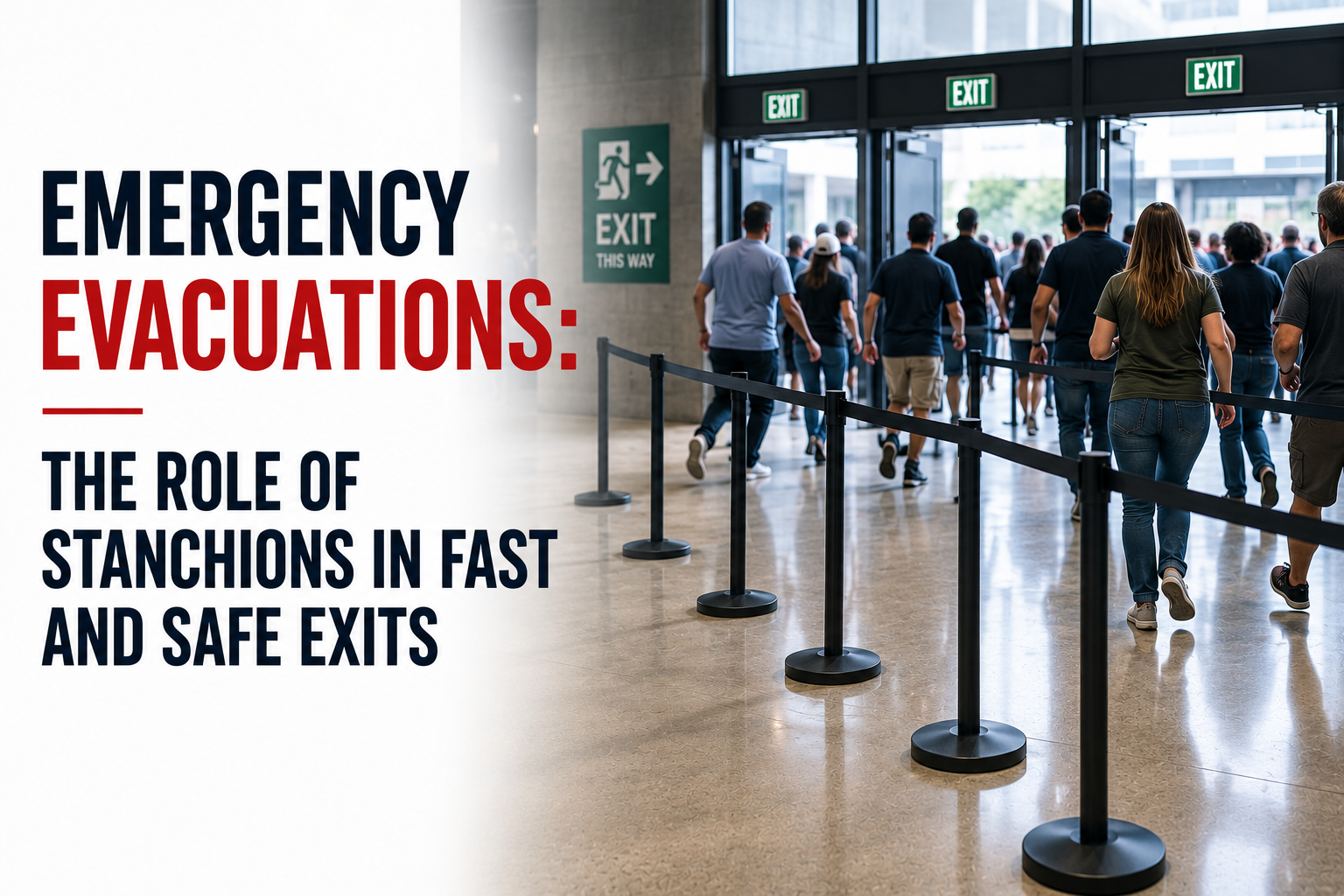
Emergency Evacuations: The Role of Stanchions in Fast and Safe Exits
In any emergency, every second counts. Efficient crowd control and clear evacuation routes are essential for maintaining public safety in retail environments, amusement parks, industrial workplaces, and other public venues. While stanchions are often associated with queue management and customer experience, their role in emergency response plans is critical.
When combined with safety applications and security frameworks, stanchions help maintain order, reduce chaos, and create safe paths toward emergency exits. Whether you’re an event planner, a facility manager, or a fire marshal enforcing fire codes, a well-planned stanchion system can make the difference between an orderly evacuation and dangerous congestion.
Why Stanchions Are Critical for Emergency Preparedness
Emergencies like fires, chemical spills, or security breaches can trigger panic, making crowd movement unpredictable and hazardous. Stanchions serve as a safety barrier, controlling people flow and reducing confusion. By defining clear pathways, stanchions improve traffic flow, prevent bottlenecks, and help customers and staff reach safety zones quickly.
Properly configured queue layouts and traffic control devices ensure smooth public movement toward emergency exits. They also reduce risks associated with hazardous areas by preventing unauthorized access. Unlike permanent barriers, stanchions allow for flexibility and rapid deployment, which is vital for emergency response plans in facilities where space management is critical.
Modern crowd control tools go beyond visual appeal—they meet industry standards and fire code compliance, which are key considerations for fire marshals and safety officers.
Types of Stanchions for Emergency Situations
1. Retractable Belt Stanchions
Retractable stanchions are the most versatile and widely used for emergency crowd control. Their adjustable belt length allows rapid creation or reconfiguration of queue systems to guide people toward safety zones. Features like magnetic belt ends, belt brakes, and rubber belt ends ensure quick setup and secure attachment to walls or posts.
Wall-mounted retractable belts are particularly useful in tight spaces, providing flexible layout configuration without cluttering the floor. These can be combined with high-visibility colors, reflective elements, and signage panels for maximum visibility even in low-light conditions. Stainless steel construction and cast-iron bases add durability for high-traffic areas.
2. Rope Stanchions and Velvet Rope Stanchions
Traditionally used in promotional areas and upscale venues, rope stanchions also have practical applications in emergencies. They can restrict access to hazardous areas or guide crowd movement during temporary closures. Velvet rope stanchions paired with post-top signage maintain visual appeal while supporting crowd management during evacuations.
3. Chain Stanchions and Plastic Stanchions
For industrial workplaces, outdoor stanchions like plastic stanchions and chain stanchions offer lightweight, cost-effective solutions for marking safety zones and hazardous areas. These stanchions are portable, making them ideal for rapid deployment when quick action is required.
Enhancing Safety with Stanchion Accessories
Stanchion accessories can significantly boost safety during emergencies. Adding signage panels or digital displays provides clear instructions for evacuation routes. Messages like “Exit This Way” or “Restricted Area” reduce confusion and accelerate crowd flow.
Other accessories such as swinging gates, literature holders for emergency maps, and post-top signage help communicate critical safety guidelines. For security frameworks, integrating stanchions with security access turnstiles and security cameras ensures controlled public movement.
Designing Effective Queue Layouts for Evacuations
Queue layouts are not only important for customer experience—they play a key role in emergencies. Incorporating queue management principles into emergency response plans ensures predictable people flow. Straight, unobstructed pathways with minimal turns are ideal for efficient movement toward exits.
Crowd control barriers like temporary closures and safety barriers can redirect traffic and prevent access to hazardous areas. These barriers also help enforce space requirements and maintain compliance with fire codes and industry standards.
For large-scale venues like amusement parks and event spaces, digital displays and signage panels can complement stanchions to guide the flow of the crowd effectively.
Training and Integration with Security Teams
Stanchions alone cannot guarantee safe evacuation without proper staff training. Employees should be trained to quickly deploy stanchion systems, manage crowd control queues, and guide customers to emergency exits. Security teams should integrate stanchion placement into broader safety guidelines and emergency response plans.
Fire marshals and event management professionals often recommend periodic drills to ensure staff are familiar with layout configuration and rapid deployment procedures. Including digital displays and security cameras in these drills strengthens preparedness and aligns with modern safety guidelines.
Real-World Applications by Venue Type
- Retail Environments: Use retractable belt stanchions to guide people flow toward emergency exits without blocking aisles.
- Amusement Parks: Deploy outdoor stanchions with high-visibility belts and reflective elements to direct large crowds quickly.
- Industrial Workplaces: Chain stanchions and plastic stanchions create safety zones around hazardous areas during emergencies.
- Event Management: Event planners can integrate stanchions with post-top signage and temporary closures to ensure smooth evacuation from concert halls or conference centers.
Common Mistakes to Avoid During Evacuations
- Overcrowding Exit Points: Poor queue layouts can cause bottlenecks, increasing wait times during critical moments.
- Using Low-Visibility Stanchions: Dark-colored or poorly marked stanchions reduce visibility, especially in smoke or dim light.
- Ignoring Staff Training: Even the best stanchion system fails without trained personnel to manage the flow of the crowd.
- Not Following Fire Codes: Non-compliance with fire marshal regulations can lead to safety risks and legal issues.
Tips for Selecting the Right Stanchion System for Emergencies
- Choose high-visibility designs with reflective elements for better visibility during low-light situations.
- Prioritize durability—stainless steel and cast-iron bases withstand heavy use.
- Ensure rapid deployment with retractable stanchions that include belt brakes and magnetic belt ends.
- Opt for wall-mounted retractable belts to save floor space.
- For outdoor use, select plastic stanchions or chain stanchions for weather resistance.
- Add communication tools like signage panels and digital displays to improve guidance during evacuations.
Benefits of Stanchions for Emergency Preparedness
- Enhances public safety by controlling crowd movement and reducing panic.
- Meets fire codes and industry standards for space management and safety zones.
- Provides flexibility for rapid deployment in different venue types.
- Improves traffic flow and reduces wait times during high-pressure scenarios.
- Maintains visual appeal while ensuring compliance with security frameworks.
- Integrates with other crowd control supplies like swinging gates and signage panels.
Conclusion
Emergencies demand preparation and precision. A well-planned stanchion system—complete with retractable belt stanchions, rope stanchions, and plastic stanchions—ensures fast and safe evacuations. When combined with staff training, security frameworks, and safety applications, stanchions transform from a queue management tool into a critical component of your emergency response plan.
Investing in the right crowd control barriers, queue systems, and traffic control devices not only enhances safety but also reinforces compliance with fire codes and industry standards. Take action today to protect your customers, staff, and facility during any emergency.