
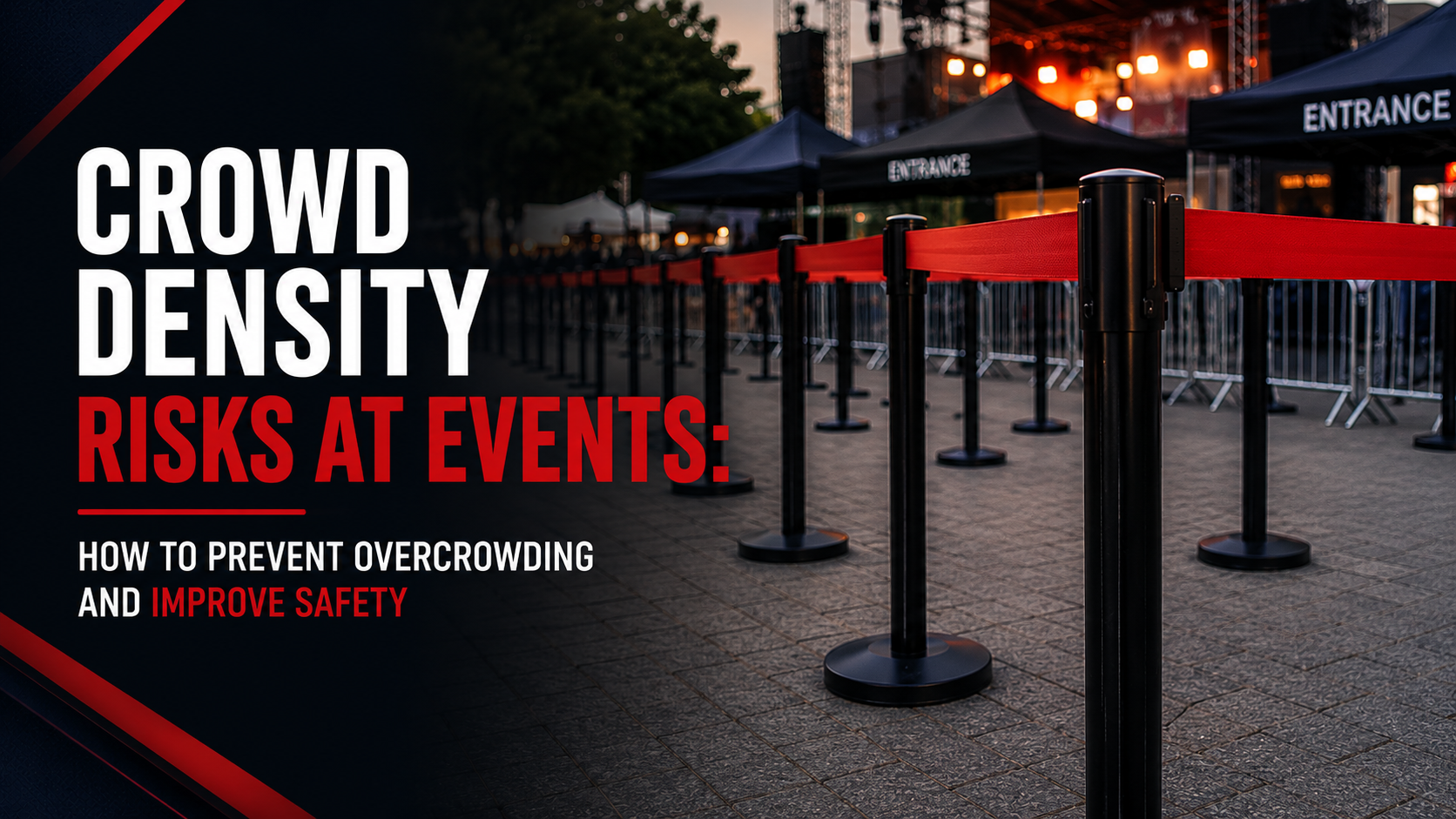
Crowd Density Risks at Events: How to Prevent Overcrowding and Improve Safety
Crowd density can change quickly when large numbers of people enter, wait, move, or gather within limited spaces. Effective crowd control is therefore about more than simply limiting attendance. Event planning should consider pedestrian routes, entrances and exits, queues, gathering points, venue layout, clear communication, and real-time monitoring. By considering these factors together, organizers can better understand changing crowd conditions and make informed adjustments when needed.
Crowd Density Risks at Events: How to Prevent Overcrowding and Improve Safety
Crowd density risks increase when too many people gather within a limited area or when pedestrian movement becomes restricted by bottlenecks, queues, poor routing, or blocked pathways. Effective crowd control can help reduce overcrowding by combining advance planning, clear routes, appropriate barriers, queue management, signage, monitoring, and timely operational adjustments.
Crowd density can change quickly at events as people enter, wait, move between areas, or gather around popular attractions. When too many people occupy a limited space, crowd density risks can increase, affecting pedestrian flow, communication, and the ability of people to move comfortably.
Effective crowd control is not simply about limiting attendance. It involves planning how people move through a venue, where they gather, how queues are managed, and how changing conditions are monitored. A practical approach to event crowd management combines capacity planning, clear communication, access control, pedestrian routes, trained personnel, and ongoing observation.
What Is Crowd Density?
Crowd density refers to how many people are occupying a specific area at a given time. Density may be low in open areas but increase quickly near entrances, exits, food and beverage stations, stages, ticket points, restrooms, or other high-interest locations.
Understanding crowd density helps event organizers identify where crowd congestion may develop and where additional crowd management measures may be appropriate.
How Crowd Density Changes During an Event
Crowd size alone does not determine density. A venue with a large attendance may have relatively open pedestrian areas, while a smaller crowd can become concentrated in a confined space.
Common situations that can increase density include:
Large groups arriving at the same time
Queues forming at entrances or service areas
People gathering near a stage or attraction
Delays at security or access points
Narrow walkways or restricted pedestrian routes
Sudden changes in weather or event conditions
People moving toward the same exit or attraction
This is why crowd flow management and real-time observation are important parts of event planning.
What Are the Main Crowd Density Risks at Events?
Crowd density risks can develop when people become concentrated in an area and normal pedestrian movement becomes increasingly difficult. The specific risks depend on the venue, event type, layout, crowd behavior, and available routes.
Crowd Congestion and Restricted Pedestrian Flow
High-density areas can make it harder for people to move naturally through a venue. Queues may extend into pedestrian routes, crossings can become blocked, or several groups may converge in the same area.
Effective crowd flow management helps organizers identify these pressure points and maintain established pedestrian routes where possible.
Confusion During Changes or Delays
Crowds may become difficult to manage when people do not know where to go or why movement has slowed. Clear signs, announcements, staff instructions, and designated routes can help provide consistent information.
Communication should form part of a broader crowd management plan, rather than being treated as a response only after congestion develops.
Increased Risk of Crowd Surge
A crowd surge can occur when a large group moves suddenly in the same direction. Events should consider how entrances, exits, barriers, queues, and high-interest areas could influence movement and identify appropriate controls during the planning process.
Not every increase in density results in a surge, but monitoring changes in crowd behavior can help event teams recognize when conditions require attention.
How Does Crowd Control Help Manage Crowd Density?
1. Assess Expected Attendance and Venue Layout
Review expected crowd size, venue dimensions, major attractions, entrances, exits, queues, service points, and areas where people are likely to gather.
2. Identify Potential Density Hotspots
Look for narrow corridors, entry gates, security checks, popular activity zones, washrooms, concessions, stages, elevators, escalators, and other areas where people may concentrate.
3. Plan Pedestrian Routes
Establish understandable routes that help people move between key areas without unnecessary crossing, backtracking, or congestion.
4. Organize Queues and Boundaries
Use suitable stanchions, barriers, signage, and queue layouts to maintain more predictable waiting and movement patterns.
5. Monitor Crowd Conditions
Observe how people actually use the space and identify growing queues, congestion, blocked routes, or changing pedestrian patterns.
6. Adjust Operations When Necessary
Follow established procedures to modify routing, staffing, queue layouts, access points, or communication when changing crowd conditions require attention.
Why Crowd Monitoring Matters
Crowd monitoring provides information about changing conditions during an event. Rather than relying only on the expected attendance figure, event teams can observe where people are gathering, how quickly areas are filling, and whether pedestrian routes remain usable.
Crowd Counting and Density Monitoring
Crowd counting can help provide an indication of how many people are entering or occupying specific areas. Depending on the event, this may involve manual counts, ticketing information, staff observations, or available technology.
Density monitoring focuses more specifically on how concentrated people are within a particular space. Both approaches can support informed decision-making when used appropriately.
Watch for Changes in Crowd Behavior
Crowd behavior can change in response to performances, announcements, delays, weather, or unexpected events. Security personnel and event staff should know what conditions they are expected to observe and how concerns should be communicated.
This makes trained observation an important component of event crowd management.
Building an Effective Crowd Management Plan
A crowd management plan should reflect the specific venue, event, expected crowd size, activities, layout, staffing, and applicable requirements. There is no single approach that works for every event.
Conduct Risk Assessments
Risk assessments can help organizers identify areas where crowd density, restricted movement, queues, access points, or changing crowd behavior could create operational challenges. Learn more about Effective Strategies for Risk Assessment in Crowd Control.
An assessment may consider:
Expected crowd size and arrival patterns
Venue capacity and usable space
Entrances, exits, and emergency routes
Pedestrian flow and potential bottlenecks
Queue locations
High-interest gathering points
Communication methods
Staffing and security responsibilities
Monitoring and escalation procedures
These considerations form part of broader Event Risk Management and should be reviewed as event conditions change.
Define Staff and Security Responsibilities
Security teams, event staff, and other personnel may have different responsibilities within an event. Roles should be clearly defined so personnel understand who monitors particular areas, who communicates with attendees, and who is responsible for escalating concerns.
Event Security should work as part of the wider event-management structure rather than operating separately from venue operations and crowd management planning.
Practical Overcrowding Prevention Strategies
Overcrowding prevention begins before attendees arrive. Organizers can use information from venue assessments, previous events, ticketing data, expected crowd size, and site layout to plan how people will move through the space.
Use Capacity Planning
Crowd capacity should be considered alongside the actual layout and usable areas of a venue. Maximum occupancy figures do not necessarily explain how people will be distributed throughout the site.
Capacity planning should therefore consider where people are likely to gather and whether sufficient routes and spaces are available for expected movement.
Maintain Clear Pedestrian Routes
Clearly identified pedestrian routes can help direct people between important areas and reduce unnecessary cross-flow. Routes should be reviewed for potential obstructions, narrow sections, and locations where queues or gatherings may form.
Good pedestrian flow supports more predictable movement and can make crowd conditions easier for staff to monitor.
Provide Clear Information
Signs, announcements, staff instructions, digital messages, and other communication methods can help attendees understand where to enter, wait, move, or exit.
Consistent information is particularly useful when routes, schedules, or access arrangements change during an event.
The Role of Crowd Control Security and Personnel
Crowd Control Security and event personnel can support crowd management by observing conditions, communicating instructions, maintaining established routes, managing queues, and escalating concerns according to the event’s procedures.
Their role should be based on the specific event and clearly defined responsibilities. Effective personnel training may include crowd psychology, communication, observation, access procedures, emergency protocols, and understanding the venue’s crowd management plan.
A Proactive Approach to Event Crowd Safety
Effective crowd safety comes from combining planning, monitoring, communication, and appropriate operational controls. It is not based on one piece of equipment, one staff member, or a single crowd-control measure.
By considering crowd density, crowd flow, crowd size, venue capacity, pedestrian routes, access points, gathering areas, and changing crowd behavior, organizers can make more informed decisions about managing event conditions.
A well-developed approach to event safety should also recognize that conditions can change quickly. Regular monitoring and clear escalation procedures allow event teams to respond to changing circumstances as part of a broader crowd management and event risk-management strategy.
Frequently Asked Question
1. What is crowd density?
Crowd density is the number of people occupying a specific area at a particular time. Density can vary across different parts of an event, even when the overall attendance remains within the venue’s planned capacity. Areas near entrances, stages, food stations, or other popular locations may become more concentrated as people gather or wait.
2. Why can high crowd density be a problem at events?
High crowd density can make pedestrian movement and communication more difficult. When people are concentrated in a limited space, queues may grow, pathways can become congested, and movement may become less predictable. Monitoring these conditions can help event teams determine when adjustments may be appropriate.
3. What causes overcrowding at events?
Overcrowding can result from several factors, including large arrivals, limited space, queues, delays, and people gathering in popular areas. Crowd behavior can also change throughout an event as attendees move toward attractions, performances, exits, or other points of interest. Effective event planning considers these changing patterns rather than attendance numbers alone.
4. What is the difference between crowd density and venue capacity?
Crowd density describes how concentrated people are within a particular space, while venue capacity refers to the number of people a space is designed or permitted to accommodate under applicable requirements. A venue may have an overall attendance level that appears manageable while certain areas experience higher density. Capacity planning should therefore consider both total numbers and how people are distributed throughout the venue.
5. How can crowd control help reduce overcrowding?
Crowd control can help organize how people enter, move through, wait within, and leave an event. Measures may include queue management, access control, directional signage, designated pedestrian routes, staffing, and crowd monitoring. The appropriate combination depends on the event layout, crowd size, activities, and operating conditions.
6. What areas of an event are most likely to become crowded?
Entrances, exits, queues, stages, food and beverage areas, restrooms, and popular attractions are common locations for higher crowd density. These areas often attract people at the same time or have limited space for movement. Identifying potential gathering points during event planning can help organizers determine where additional monitoring or circulation measures may be useful.
7. How can organizers monitor crowd density?
Organizers can monitor crowd density through staff observations, crowd counting, available technology, and regular checks of key areas. Monitoring can help identify changes in crowd size, queue growth, restricted pedestrian routes, or unusually concentrated groups. The method used should be appropriate for the venue, event, available resources, and applicable requirements.
8. How do barriers and stanchions help manage crowds?
Barriers and stanchions can help define queues, separate pedestrian routes, and guide people toward designated areas. They can provide a visible structure for organizing movement, particularly around entrances, service points, or waiting areas. Their placement should be considered alongside the overall venue layout so that they do not unnecessarily restrict established pedestrian routes.
9. How can queues affect crowd density?
Queues can increase crowd density when waiting areas are too small or when people spill into nearby pedestrian routes. Organizers can plan designated queue areas, provide clear directions, monitor queue growth, and review service capacity where appropriate. Queue management should also consider how people enter and leave the line without interfering with other movement.
10. What is crowd flow management?
Crowd flow management is the planning and coordination of how people move through an event space. It considers entrances, exits, pedestrian routes, queues, gathering points, and areas where different movement patterns may intersect. Effective planning aims to make movement more organized while allowing event teams to respond to changing conditions.
11. What should be included in a crowd management plan?
A crowd management plan should address the specific conditions of the event and venue. It may include expected crowd size, capacity considerations, entry and exit procedures, pedestrian routes, queue arrangements, communication methods, staffing responsibilities, monitoring procedures, and escalation processes. The plan should be informed by site-specific risk assessments and applicable requirements.
12. Can crowd monitoring prevent every crowd-related incident?
No, crowd monitoring cannot prevent every crowd-related incident. Monitoring is one part of a broader event safety and crowd management approach and can provide useful information about changing conditions. Organizers should combine monitoring with appropriate planning, communication, staffing, and response procedures based on the circumstances of the event.
Common Crowd Density Risks and Possible Planning Responses
Crowd Density Issue | Common Cause | Possible Planning Response |
|---|---|---|
Entrance congestion | Large numbers arriving at once | Review entry lanes, staffing, signage, and arrival procedures |
Long queues | Limited service or screening capacity | Improve queue organization and monitor queue growth |
Narrow pedestrian routes | Venue layout constraints | Review routing and keep pathways as clear as practical |
Cross-traffic | Opposing pedestrian movements | Separate movement directions where appropriate |
High-density gathering areas | Popular attractions or activities | Monitor the area and review access and circulation plans |
Exit congestion | Large numbers leaving simultaneously | Review exit routes, signage, and departure procedures |
Confusing movement | Poor wayfinding | Improve directional signage and staff communication |
Note: These are general crowd-management considerations, not universal solutions. The appropriate response will depend on the specific venue layout, event type, expected crowd size, staffing, applicable requirements, and conditions at the time. Planning decisions should be based on a site-specific assessment and reviewed as circumstances change.
Plan Ahead for Better Crowd Management
Before an event, review attendance expectations, venue layout, pedestrian routes, queues, entrances, exits, signage, and known crowd-density hotspots. Considering these factors in advance can help identify potential congestion points and support practical crowd management decisions.
For larger, more complex events, or situations involving higher expected crowd density or specific regulatory requirements, consider obtaining guidance from qualified crowd-management or event-safety professionals. Their expertise can help ensure planning decisions are appropriate for the venue, event conditions, and applicable requirements.