
- September 30, 2026
- Crowd Control Barriers
- crowd control, Crowd Control Accessories, Crowd Control Stanchions, Crowd Control Systems, Metal Sign Frames, Queue Management, Queue Management System, Retractable Belt Barriers, Retractable Belt Stanchions, Sign Holders for Stanchions, Stanchion sign frames, Stanchion Signage, Stanchion Signs
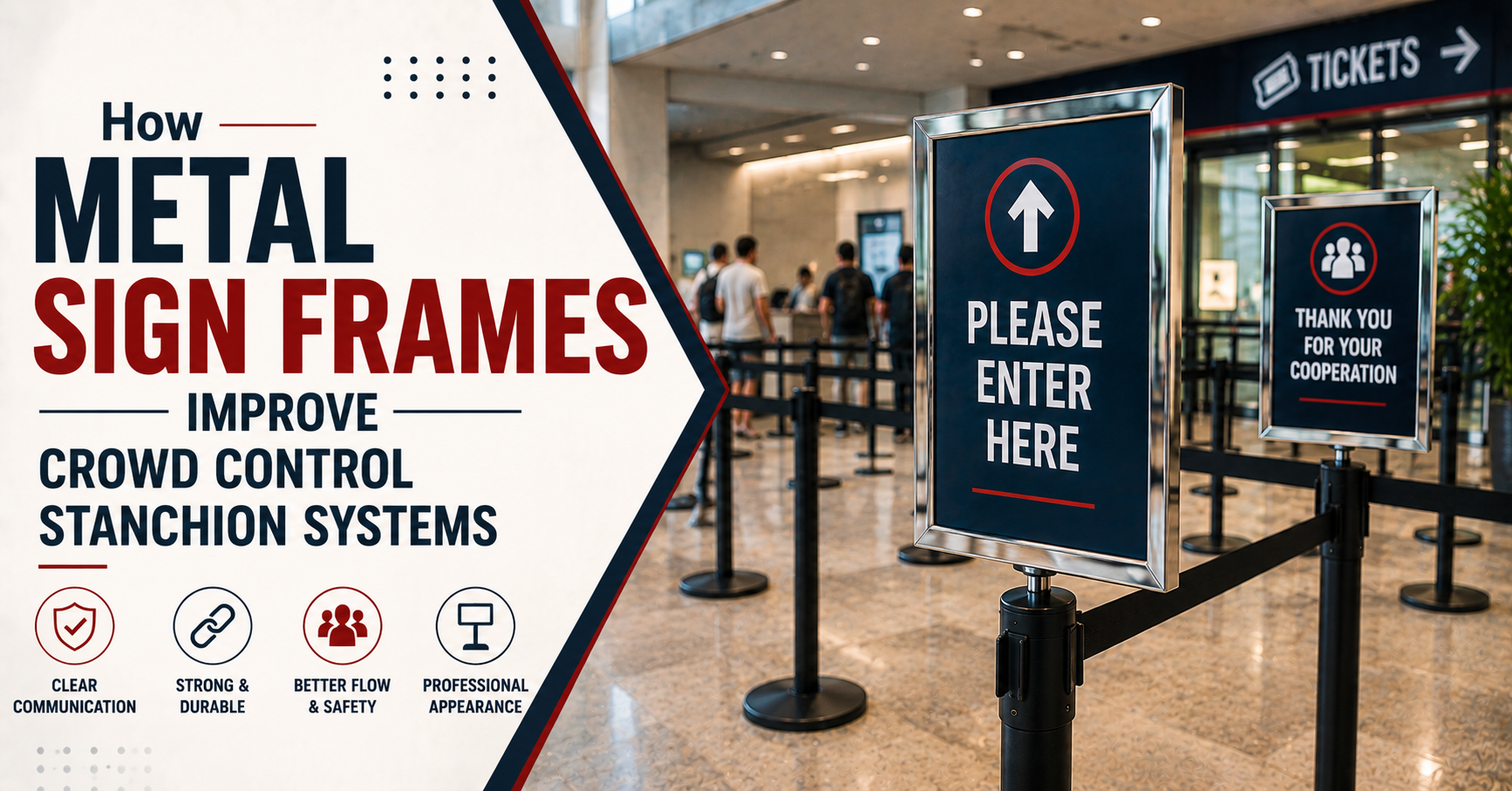
How Metal Sign Frames Improve Crowd Control Stanchion Systems
Effective crowd control depends on more than physical barriers and stanchions. Clear communication is equally important for helping people understand where to go, how to queue, and what is expected of them. Within a broader crowd control system, metal Sign Frames can provide visible directions, queue rules, access information, check-in instructions, and other important messages.
When paired with crowd control stanchions, sign frames help turn physical boundaries into a more understandable queue management system. By providing clear information at key points, sign frames, sign stands, and custom signage can support customer flow, reduce confusion, and help people navigate Queue Systems more efficiently. This makes signage a practical complement to stanchions in organized spaces where both movement and communication matter.
How Metal Sign Frames Improve Crowd Control Stanchion Systems
Metal sign frames improve crowd control stanchion systems by adding clear, visible instructions directly where people enter, wait, or move through a space. When paired with appropriate stanchions, sign frames can help communicate directions, queue rules, access restrictions, check-in information, and wayfinding cues without requiring separate floor or wall signage.
Effective crowd control is about more than placing barriers in the right locations. People also need clear, visible information to understand where to line up, which direction to walk, where to check in, and which areas may be restricted. This is where metal sign frames and stanchion signage can add an important communication layer to a physical crowd control setup.
When combined with crowd control stanchions, retractable belt stanchions, and queue barriers, stanchion sign frames help create a more organized and understandable environment. From airports and event spaces to retail locations, hotels, healthcare facilities, and other high-traffic environments, well-positioned signage can support queue management, pedestrian guidance, and smoother customer flow.
How Metal Sign Frames Support Crowd Control
A stanchion creates a physical boundary, but it does not necessarily tell people what they should do next. Stanchion signs and sign holders for stanchions can provide that missing information.
For example, a sign can communicate:
Where a queue begins
Which line customers should use
Where to check in
Which entrance or exit to use
Where accessibility services are located
Whether an area is temporarily restricted
Where customers should proceed after completing a step
This combination of physical barriers and clear messaging creates a more complete Public Guidance System.
Supporting Pedestrian Guidance
Good directional signage can help people make decisions before they reach a congested area. When signs are positioned at appropriate points along queue barriers or pedestrian routes, visitors can receive instructions without having to stop and ask staff for assistance.
Making Queue Management More Efficient
Queue management involves more than creating a line. People need to know where the line starts, where it leads, and what they should do when they reach the front. Stanchion sign frames can provide this information while retractable belt barriers help define the physical path.
Combining Stanchion Sign Frames With Crowd Control Stanchions
Crowd control stanchions provide flexibility because their placement can be changed as customer flow or venue requirements change. Adding a Sign Frame or stanchion top signs provides a visible location for instructions without requiring a separate sign stand.
Depending on the application, a setup may include:
Retractable belt stanchions
Stanchion sign frames
Sign holders for stanchions
Queue signage
Signage brackets
Literature holders
Brochure Holder or Pamphlet Holder
Other crowd control accessories
These components can be configured according to the layout and communication needs of the space.
Why Signage Matters in High-Traffic Environments
In high-traffic environments, confusion can quickly contribute to unnecessary congestion. Clear signage helps visitors understand established routes and instructions before they reach decision points.
For example, an event space may use custom signage to identify registration lines, while a retail location may use queue signage to separate checkout or service areas. Airports, hotels, public facilities, and other venues can similarly use signs to provide pedestrian guidance alongside physical queue barriers.
The goal is not simply to add more signs. The goal is to place useful information where people are most likely to need it.
Supporting Crowd Management
Crowd management involves coordinating people, spaces, information, and procedures. Signage can support this process by reinforcing instructions that staff are already providing.
It can also help reduce repeated questions about basic directions, allowing personnel to focus on monitoring conditions and assisting visitors when needed.
Materials and Mounting Options for Stanchion Signage
Metal sign frames are available in different finishes and configurations to suit the environment. Stainless Steel options, for example, may be appropriate for locations where durability and a professional appearance are important.
Depending on the installation, signage may use:
Sign stands
Stanchion accessories
Wall mounts
Wall clips
Signage brackets
Aluminum Wall Receptacle
Logo mats
Literature holders
The appropriate combination depends on the venue, traffic level, sign size, and intended use.
Using Sign Frames as Part of a Broader Crowd Control System
A sign frame should not be viewed as a replacement for proper planning, trained personnel, or appropriate barriers. Instead, it can complement other crowd control systems by making established instructions easier to see and understand.
For example, retractable belt stanchions can establish a defined queue while a stanchion sign explains where the queue leads. In another setting, a wall-mounted sign may provide general directions while stanchions guide people through a temporary service area.
Together, these elements can support line management solutions, traffic control, and organized customer movement. Learn more about how to Maximize Impact with Stanchions with Signs for Effective Crowd Control.
Signage and Venue Security
Clear communication can also support venue security by helping visitors understand access restrictions, designated entrances, and approved pedestrian routes. Signage should reinforce the venue’s established procedures rather than replace staff judgment or security protocols.
Frequently Asked Questions About Metal Sign Frames and Crowd Control
1. What is a metal sign frame for a stanchion?
A metal sign frame is a holder that attaches to a stanchion post to display printed signs or notices. It provides a visible, organized way to communicate information to people moving through a queue or controlled area. Available designs and attachment methods vary by stanchion system and manufacturer.
2. How do sign frames improve crowd control?
Sign frames improve crowd control by making important instructions easier to see and understand. They can help communicate queue directions, entry requirements, access restrictions, or other venue information before people reach a controlled point. Clear signage can support staff efforts to manage pedestrian flow.
3. Can metal sign frames be used with retractable belt stanchions?
Yes, many metal sign frames are designed to work with retractable belt stanchions. Compatibility depends on the post, frame attachment system, and manufacturer specifications. Always confirm that the frame is designed for the specific stanchion model before use.
4. What information should be displayed on stanchion signs?
Stanchion signs should display short, clear information that helps people understand what to do. Examples include queue directions, entrance and exit information, event rules, accessibility instructions, and temporary access notices. The content should match the venue, event, and specific crowd-management needs.
5. What size sign frame should I choose?
Choose a sign frame based on the amount of information, viewing distance, and available stanchion space. Larger frames may be more suitable for detailed notices, while smaller frames can work well for brief instructions or directional messages. Check the manufacturer’s recommended insert size and frame dimensions before purchasing.
6. Are metal sign frames better than plastic sign holders?
Not necessarily, because the better option depends on the application. Metal frames may offer a sturdy, professional appearance and can be suitable for frequent use, while plastic holders may be lighter and more economical. Consider durability, weight, appearance, cost, and intended environment when comparing options.
7. Can stanchion sign frames be used outdoors?
Some stanchion sign frames can be used outdoors, but suitability depends on the frame and its construction. Consider the frame’s finish, insert protection, exposure to rain, wind, sunlight, and other weather conditions. Always follow the manufacturer’s outdoor-use specifications.
8. Where should stanchion signs be placed?
Stanchion signs should be placed where people have enough time and space to read them before making a decision or reaching a controlled point. Common locations include queue entrances, decision points, access areas, and near staff-controlled checkpoints. Placement should avoid blocking pedestrian routes or creating additional obstacles.
9. Can stanchion signs be changed for different events?
Yes, many sign frames allow printed inserts to be replaced as requirements change. This makes them useful for venues that host different events or need temporary instructions. The insert format and replacement process depend on the specific frame design.
10. What should I consider when choosing a metal sign frame?
Consider compatibility, sign size, visibility, durability, installation method, and the environment where it will be used. It is also important to consider how frequently the signs will be changed and whether the frame needs to withstand outdoor conditions. Available features vary by product and stanchion system, so check the manufacturer’s specifications before selecting a frame.
Metal Sign Frame Features and Their Common Uses
Feature | Why It Matters | Common Use |
|---|---|---|
Portrait orientation | Supports vertical instructions or notices | Queue rules, access information |
Landscape orientation | Provides wider display space | Directions, check-in instructions |
Metal construction | Supports repeated use in busy environments | Retail, hospitality, venues |
Replaceable inserts | Makes messages easy to update | Events, changing queue procedures |
Stanchion mounting | Integrates signage into an existing queue | Entrances, service lines |
Clear sign cover | Helps protect and display printed inserts | Indoor public spaces |
Double-sided display | Allows information to be viewed from multiple directions | Intersections and high-traffic areas |
Available features can vary depending on the specific metal sign frame, manufacturer, and stanchion system. Options such as orientation, mounting style, insert design, and single- or double-sided display should be selected based on the venue layout, signage needs, and intended use.
The Bottom Line
Effective crowd control combines physical organization with clear communication. Metal sign frames, stanchion signs, queue signage, and directional signage can complement crowd control stanchions by telling people where to go and what to do. Used as part of a broader crowd management plan, these tools can help create clearer queues, improve pedestrian guidance, and support more organized movement through busy spaces.