
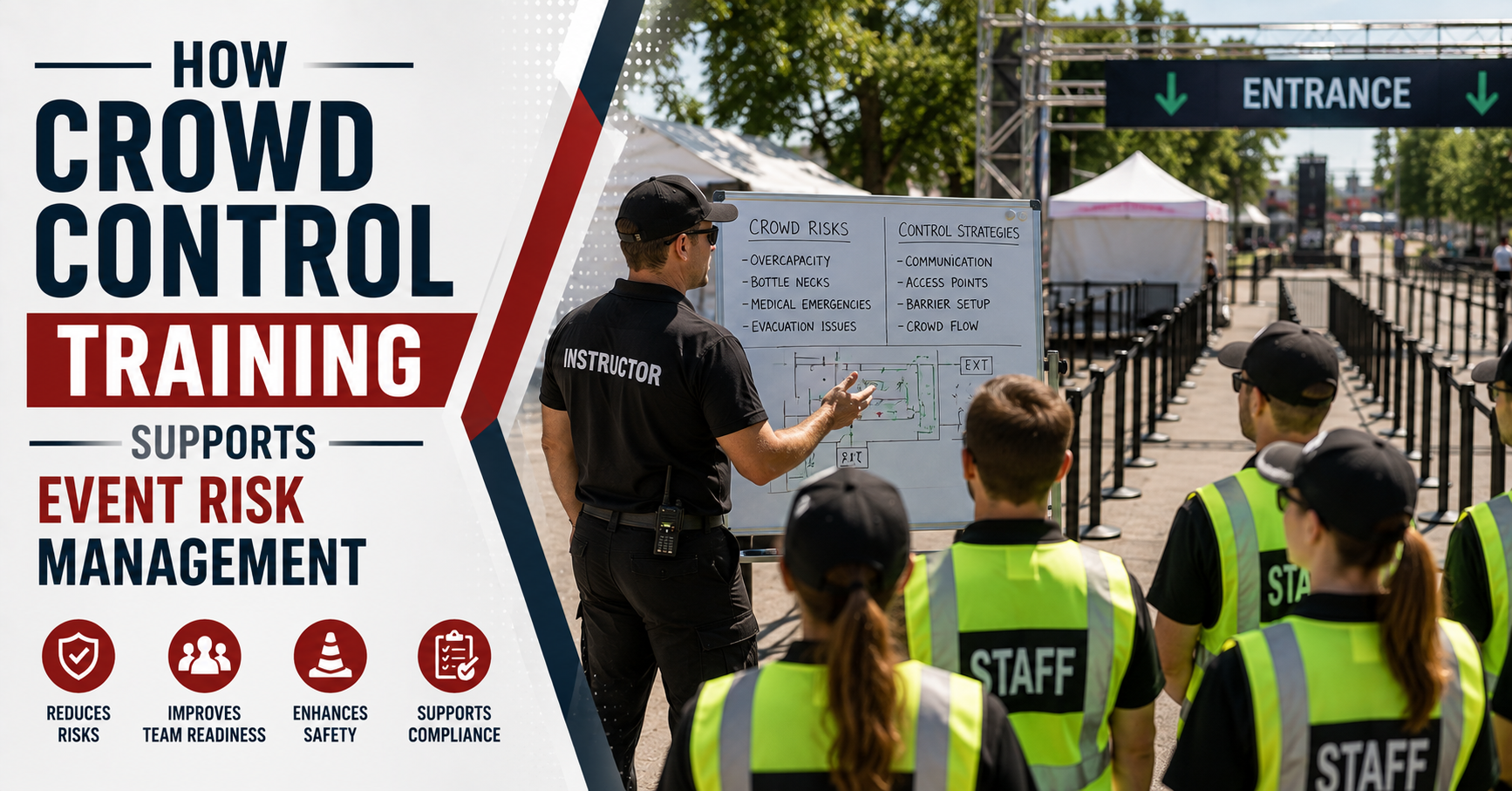
How Crowd Control Training Supports Event Risk Management
Effective event risk management involves more than placing barriers, putting up signs, or assigning security personnel. It requires a coordinated approach that considers how people enter, move through, queue within, and leave an event space. Crowd control is one important part of this broader approach, helping teams maintain organized movement while responding to changing conditions.
Trained staff can play a valuable role by observing crowd conditions, communicating clear instructions, managing queues, maintaining established pedestrian routes, and escalating concerns when additional support is needed. Their awareness and decision-making can complement physical equipment, event procedures, and security measures.
However, training is only one component of effective event management and does not guarantee that incidents will not occur. Instead, it helps equip event teams with practical knowledge and procedures to identify potential concerns, respond appropriately, and support safer, more organized event operations.
How Crowd Control Training Supports Event Risk Management
Crowd control training supports event risk management by helping staff understand pedestrian movement, recognize potential crowd-related problems, communicate consistently, and follow established procedures when conditions change. When combined with appropriate planning, signage, barriers, queue layouts, monitoring, and professional oversight where needed, training can contribute to a more organized approach to managing attendees.
A successful event is about more than getting people through the door. When hundreds or thousands of guests gather in one place, organizers must understand how people will enter, move, queue, interact, and respond when conditions suddenly change. This is where crowd control training becomes an important part of effective event risk management.
Well-trained event teams can recognize changing crowd behavior, manage pedestrian movement, identify potential hazards, and respond appropriately when conditions become difficult. Effective crowd management is not about unnecessarily restricting guests. It is about creating an environment where movement is organized, risks are identified early, and people can enjoy the event safely.
From crowd flow management and queue management to emergency response and evacuation planning, proper training gives event staff the practical knowledge needed to make informed decisions when it matters most.
What Is Crowd Control Training?
Crowd control training teaches event personnel how to safely manage the movement, behavior, and density of people in public spaces. Training may cover crowd safety principles, communication, pedestrian flow, queue management, access control, crowd monitoring, risk assessment, and emergency response.
The goal is not simply to tell people where to stand or walk. Staff also need to understand how crowds behave and how small changes in a venue can affect overall movement.
Effective training can prepare teams to:
- Identify potential crowd safety risks
- Monitor changes in crowd density
- Manage entrances, exits, and queues
- Apply appropriate crowd control techniques
- Recognize unusual crowd behavior
- Maintain clear pedestrian routes
- Support event security operations
- Communicate during incidents
- Assist with emergency evacuation
- Coordinate with emergency services
Why Crowd Control Matters for Event Risk Management
Event risk management involves identifying potential hazards, evaluating their impact, and putting measures in place to reduce those risks.
Crowd-related risks can change quickly. A manageable queue can become overcrowded when arrival numbers increase unexpectedly. A clear walkway can become blocked when guests stop to watch an activity. A delay at an entrance can also create a queue that affects nearby pedestrian traffic.
This is why crowd risk assessment should consider more than expected attendance. Organizers should evaluate:
- Expected attendance and peak arrival times
- Venue layout and pedestrian space
- Entrance and exit capacity
- Security screening requirements
- Queue lengths and waiting areas
- Potential crowd bottlenecks
- Crowd density
- Emergency access routes
- Staffing requirements
- Accessibility needs
This type of risk analysis helps identify where additional controls, personnel, or equipment may be necessary.
Understanding Crowd Science and Crowd Behavior
Crowds are influenced by their surroundings, the information available to them, and the actions of people nearby. Understanding basic crowd science can help staff make better decisions when conditions change.
How Crowd Dynamics Affect Safety
Crowd dynamics describe how people move and interact within a shared space. As crowd density increases, individuals have less room to change direction or move freely. Confusing instructions or opposing movement routes can make the situation more challenging.
Training helps staff recognize these changes and take appropriate action before they develop into more serious crowd safety concerns.
Using Crowd Modelling for Planning
For large or complex events, crowd modelling can help organizers examine how people may move through a venue under different conditions.
It can support planning for:
- Venue entry and exit
- Pedestrian flow
- Queue formation
- Crowd density
- Emergency evacuation
- Alternative routes
- Security checkpoints
Crowd modelling cannot predict every real-world situation, but it can help identify potential pressure points before an event begins.
Crowd Flow Management and Pedestrian Flow
One of the most practical parts of crowd management training is learning how to maintain safe and efficient movement.
Crowd flow management considers how people travel from one area to another, including entrances, queues, walkways, activity areas, concessions, and exits.
Managing Pedestrian Flow
Effective pedestrian flow requires more than creating a pathway. Routes should be easy to understand, suitable for expected traffic, and designed to minimize conflicting movement.
Event teams may use:
- Directional signage
- Crowd control barriers
- Designated entry and exit routes
- Queue systems
- Staff at key decision points
- Temporary access controls
- Clear communication procedures
The objective is to make safe movement as intuitive as possible for guests.
Queue Management and Crowd Density
Queues are common at events, but poorly managed queues can become a crowd safety concern.
Queue management training helps staff recognize when a normal waiting line is becoming too long, too dense, or disruptive to surrounding pedestrian traffic. Effective queue management creates better customer experience with smart queue solutions. Read more about it here.
Monitoring Crowd Density
Crowd density management involves observing how closely people are gathered within an area. Staff should watch for increasing queue pressure, reduced walking space, blocked entrances, people moving against the intended flow, and sudden changes in crowd movement.
Active crowd monitoring allows teams to make adjustments before congestion develops into a larger safety issue.
The Role of Event Staff Training
Technology and equipment can support crowd control, but trained people remain essential. Event staff training gives employees the knowledge and confidence to recognize developing risks and understand what action to take.
Training should cover:
Communication
Staff should know how to give clear, calm instructions and communicate changes without creating unnecessary confusion.
Observation
Employees need to recognize changes in crowd density, movement, and behavior.
Decision-Making
Teams should understand when to adjust queues, redirect guests, request additional support, or escalate an issue.
Coordination
Crowd management often involves several teams, including event operations, Event Security, medical personnel, venue management, and emergency services. Effective coordination ensures everyone understands their responsibilities.
Crowd Control Techniques That Support Event Safety
There is no single crowd control technique suitable for every event. The appropriate approach depends on the venue, audience, event type, attendance, and potential risks.
Common techniques include:
- Establishing clearly defined pedestrian routes
- Separating incoming and outgoing traffic
- Using crowd control barriers
- Creating organized queue areas
- Positioning trained staff at key locations
- Maintaining emergency access routes
- Using access control at restricted areas
- Providing clear signage and announcements
- Monitoring crowd density
- Adjusting routes as conditions change
The most effective strategies are flexible enough to adapt throughout the event.
Crowd Control and Event Security
Event security and crowd management work closely together, although they serve different functions. Security personnel may focus on access control, prohibited items, suspicious activity, and security threats, while crowd management teams focus on movement, queues, congestion, and guest assistance.
Both functions need to communicate effectively.
Access Control
Effective access control helps ensure that guests enter the correct areas while restricted zones remain protected. Poorly managed access points can create both security concerns and crowd safety risks.
Crowd Control Security
Crowd Control Security may include trained personnel, barriers, monitoring systems, access procedures, and established response protocols. The goal is to maintain a secure environment without unnecessarily disrupting guest movement.
Preparing for Emergencies
Even excellent planning cannot eliminate every risk. Events need an emergency response plan that explains how staff should respond when something unexpected happens.
Potential scenarios include:
- Medical emergencies
- Fire or smoke
- Severe weather
- Security threats
- Sudden crowd surges
- Equipment failures
- Evacuation situations
- Unexpected venue closures
Emergency Response and Evacuation
During an emergency, confusion can spread quickly if guests do not know where to go. A well-developed emergency evacuation strategy should identify suitable exits, alternative routes, assembly areas, emergency access points, and staff responsibilities.
Event teams should also understand how to coordinate with emergency services and follow established procedures rather than improvising under pressure.
Frequently Asked Questions
1. What is crowd control training?
Crowd control training teaches personnel how to monitor crowd conditions, manage pedestrian movement, communicate instructions, and follow established procedures. Content should reflect the venue, event, staff role, and applicable requirements.
2. Why is crowd control important at events?
Crowd control helps organize pedestrian movement and reduce congestion or confusion. It is one part of a broader event-management approach.
3. How does crowd control training support event risk management?
Training helps staff recognize changing crowd conditions and respond according to established procedures. It can complement event planning, staffing, communication, and emergency arrangements.
4. What should crowd control training include?
Training may cover crowd awareness, communication, queue management, pedestrian routing, congestion awareness, and escalation procedures. Topics should be tailored to the specific event and staff responsibilities.
5. What is the difference between crowd control and crowd management?
Crowd control generally focuses on directing or limiting movement, while crowd management involves broader planning and organization of people throughout an event. Both approaches can work together depending on the situation.
6. How can event staff identify crowd congestion?
Staff can look for increasing crowd density, slower movement, longer queues, blocked routes, or difficulty moving through an area. They should follow established procedures for reporting and addressing concerns.
7. What equipment is commonly used for crowd control?
Common equipment includes barriers, stanchions, signs, cones, and other pedestrian-routing tools. Selection depends on the venue, event layout, expected attendance, and operational needs.
8. How do barriers and stanchions support crowd management?
Barriers and stanchions help define pedestrian routes, organize queues, and separate designated areas. Their effectiveness depends on appropriate placement and integration with the overall event plan.
9. What role does communication play in crowd control?
Communication helps staff coordinate actions and provide clear information to attendees. Depending on the event, this may involve radios, signage, public-address systems, or direct instructions.
10. Does crowd control training prevent incidents?
No, training cannot guarantee that incidents will not occur. It helps personnel understand their responsibilities and follow established procedures when conditions change.
Crowd Control Training Areas and Their Role in Event Risk Management
|
Training Area |
What Personnel Learn |
Potential Risk-Management Value |
|---|---|---|
|
Crowd awareness |
How to observe changes in crowd conditions |
Supports earlier identification of developing issues |
|
Pedestrian flow |
How attendees move through the venue |
Helps identify congestion and route conflicts |
|
Queue management |
How to organize and monitor waiting areas |
Supports clearer, more consistent queues |
|
Communication |
How and when information is shared |
Improves coordination between staff |
|
Equipment use |
Appropriate use of barriers, stanchions, and signage |
Supports consistent application of crowd control equipment |
|
Entrance and exit management |
How established access routes should operate |
Supports organized attendee movement |
|
Escalation procedures |
When concerns should be reported |
Helps ensure responsible personnel receive important information |
Crowd control training should reflect the specific venue, event, staff roles, and applicable requirements. Content should address relevant layouts, pedestrian routes, entry and exit points, communication procedures, equipment, and potential crowd concerns so personnel receive practical guidance suited to their responsibilities.
A Proactive Approach to Crowd Risk Analysis
Effective crowd control should be proactive rather than purely reactive. A crowd risk analysis should consider how crowd conditions may change throughout the event.
For example, crowd density may be low during early hours, increase rapidly during peak arrival, reach higher levels around major activities, and create heavy pedestrian movement when the event ends.
Recognizing these patterns allows organizers to adjust staffing, barriers, access control, and monitoring before pressure builds.
Final Thoughts
Crowd control is an essential part of responsible event planning because crowd conditions can change quickly. Effective crowd management training helps event teams understand crowd behavior, monitor crowd density, manage pedestrian flow, support event security, and respond appropriately when risks emerge.
When event organizers combine crowd risk assessment, trained staff, practical crowd control techniques, emergency response planning, and ongoing monitoring, they are better prepared to protect guests while keeping the event running smoothly.
Ultimately, effective event risk management is about preparation. The goal is not to assume everything will go according to plan, but to ensure the team is ready to respond when it doesn’t.